2012 Program Year End Summary
The Texas Boll Weevil Eradication Foundation
(TBWEF) completed a successful year in 2012. Boll weevil eradication
activities were carried out in all Texas and eastern New Mexico cotton
fields, on a total of approximately 6.7 million certified land cotton
acres. For the year, boll weevils were captured in only three of
the sixteen Texas eradication zones. Of the three remaining
zones, boll weevil numbers were reduced substantially in the South
Texas Winter-Garden (STWG) zone and the Southern Blacklands (SBL)
zone. The Lower Rio Grande Valley (LRGV) zone captured
approximately the same number of boll weevils in 2012 as were captured
in 2011.
West Texas Zones
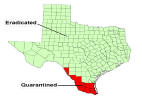
In the 5.89 million land acres that make up the 11 West Texas zones in
2012, there were no boll weevils captured and there were no acres
treated. All 11 West Texas zones have been declared functionally
eradicated.
South and East Texas Zones
The South and East Texas zones planted
approximately 890,000 acres in 2012. All boll weevils captured
in the state of Texas and all acres treated were within these zones in
2012. Through the first part of December 2012, there were
208,678 weevils captured compared to 209,294 captured in 2011.
Only three of the five zones captured weevils in 2012. The Upper
Coastal Bend zone and the Northern Blacklands zone did not capture a
weevil in 2012. The number of acres treated in two of the South
and East Texas zones decreased in 2012. The Southern Blacklands
zone treated 60,752 acres in 2011 and treated 3,902 in 2012. The
South Texas Winter Garden zone treated 42,651 acres in 2011 and
treated 21,491 in 2012. The increase in treatments occurred
entirely in the LRGV.
In the STWG zone, 34 weevils were
captured in 2012 compared to 174 weevils captured in 2011, or an 80.4
percent reduction in boll weevil numbers. Most of the weevils
captured in STWG were captured near the border with the LRGV zone.
In SBL, 2 weevils were captured in 2012 compared with 28 in 2011, or a
92.8 percent reduction in boll weevil numbers. The 2 weevils
were captured in separate months with the last capture occurring in
July. The Foundation failed to find any fields with reproduction in
SBL during the 2012 season.
The Lower Rio Grande Valley of Texas
decreased their acreage 27 percent in 2012. Boll weevil numbers
remained relatively the same with 208,642 weevils in 2012 to 209,092
in 2011. Acreage treated for boll weevils also increased from
780,027 acres in 2011 to 899,870 in 2012. The LRGV zone
continues to experience challenges in the program. Some of the
high weevil count fields are located in drug trafficking areas and
there are safety issues associated with trap inspection and treatment.
Most weevil captures are occurring in the border area along the Rio
Grande River. Northern Mexico did not plant cotton in 2009 and
the LRGV experienced greatly reduced numbers at that time. Since
then weevil numbers have failed to decrease substantially. The
National Cotton Council has initiated an International Technical
Advisory Committee to improve communication and enhance program
progress on both sides of the border.

|